What Wood To Avoid In Micro Hugelkultur Beds: 9 Types To Skip
Create A Suitable Growing Environment
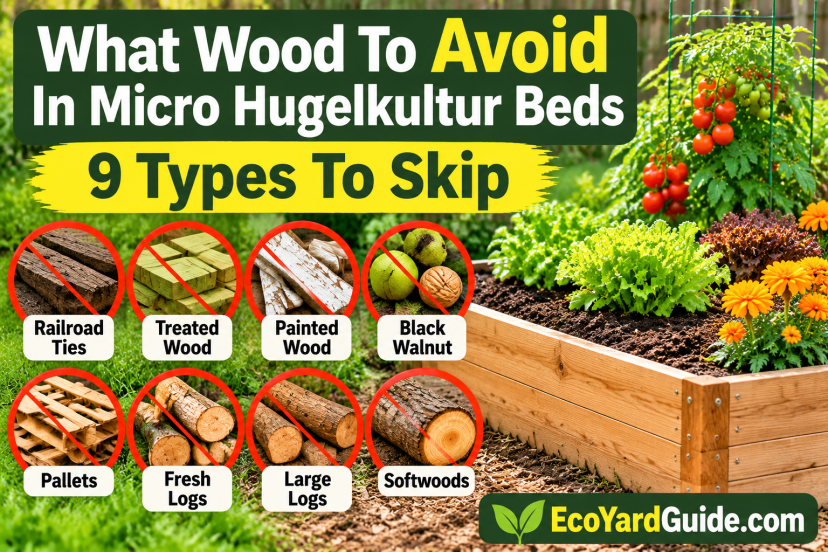
Knowing what wood to avoid in micro hugelkultur beds is essential when building a safe, productive raised garden. The most important materials to avoid are chemically contaminated wood, painted or treated scraps of unknown origin, and wood from potentially contaminated sites.
Some natural wood types also deserve caution. Black walnut contains juglone, a compound that can affect sensitive plants, while very fresh wood and large, slow-decomposing logs can create practical problems involving nitrogen availability and soil settling.
For a small raised bed, clean, untreated, partially decomposed branches from a known tree species are generally a more practical choice than construction scraps or large fresh logs.
The goal is not simply to fill the bottom of a garden bed cheaply. It is to create a suitable growing environment without introducing unnecessary contamination risks or sacrificing valuable rooting space.
Quick Answer – What Wood Should You Avoid In Micro Hugelkultur?
Avoid wood that may introduce harmful substances into vegetable-growing soil, along with materials that create unnecessary decomposition problems.
The highest-priority exclusions are:
-
Chemically contaminated wood: Wood exposed to pesticides, industrial chemicals, fuel, or other contaminants.
-
Railroad ties and utility poles: These may contain creosote or other industrial preservatives.
-
Painted or coated wood: Older coatings may contain lead or other undesirable substances.
-
Unknown construction lumber: Its treatment history may be impossible to verify.
-
Black walnut wood: Juglone can affect susceptible plants, particularly tomatoes and other sensitive crops.
Fresh wood, large hardwood logs, resinous softwoods, and diseased branches require more nuanced decisions. They are not necessarily toxic or universally unsuitable, but their characteristics can make them less desirable in compact raised beds.
Best general rule: If you cannot identify the wood or establish whether it has been treated or contaminated, do not bury it in a food-growing bed.
What Wood To Avoid In Micro Hugelkultur Beds – Safety Comparison
| Wood Type | Main Concern | Recommendation |
|---|---|---|
| Creosote-treated railroad ties | Industrial chemical contamination | Avoid |
| Unknown pressure-treated lumber | Uncertain preservative history | Avoid as buried fill |
| Painted or coated wood | Potentially hazardous coatings | Avoid |
| Wood from contaminated sites | Unknown chemical exposure | Avoid |
| Black walnut | Juglone sensitivity | Avoid for sensitive vegetables |
| Unknown pallets | Possible contamination or treatment | Avoid unless verified |
| Fresh wood chips or branches | Nitrogen immobilization | Use cautiously |
| Large dense hardwood logs | Slow decomposition and settling | Limit in shallow beds |
| Resinous softwoods | Variable decomposition and soil effects | Evaluate individually |
Not every material in this table poses the same level of risk. Chemical contamination is a more serious concern than slow decomposition, and some wood types are simply inconvenient rather than dangerous.
Why Wood Selection Matters In Small Raised Beds
Traditional hugelkultur often uses substantial quantities of woody material beneath soil. A micro hugelkultur bed applies a similar concept on a smaller scale, usually inside a compact wooden or metal raised-bed frame.
This makes material selection particularly important.
In a 4×4 raised bed measuring 18 inches deep, a 4-inch woody base occupies approximately 22% of the total bed depth. Larger pieces can reduce the amount of suitable planting soil available to vegetables.
Wood also changes as it decomposes. Microorganisms consume carbon-rich material, nutrients move through the soil system, and the original pieces gradually lose volume.
The practical concerns fall into three categories:
-
Contamination: Preservatives, coatings, or pollutants may introduce unwanted substances.
-
Plant compatibility: Certain species contain compounds that can interfere with sensitive plants.
-
Decomposition behavior: Fresh or oversized wood may contribute to nitrogen immobilization, settling, or uneven moisture distribution.
University extension publications caution that hugelkultur’s claimed water-saving and productivity benefits have limited direct scientific support. It should therefore be treated as an optional gardening technique rather than a proven improvement over conventional raised-bed soil.
1. Avoid Railroad Ties And Creosote-Treated Wood
Railroad ties are among the clearest examples of wood that should not be buried in vegetable-growing soil.
Many traditional railroad ties have been treated with creosote, a wood preservative containing numerous chemical compounds.
Creosote-treated materials are not appropriate for direct contact with soil used to grow food.
How To Recognize Potentially Creosote-Treated Wood
Possible warning signs include:
-
Dark brown or black staining.
-
An oily or tar-like surface.
-
A strong petroleum-like odor.
-
Previous use as railroad ties or industrial landscaping timbers.
Appearance alone cannot reliably establish whether wood is treated or safe.
Safer alternative: Use clean, untreated branches from a known source, or skip the woody layer and fill the bed with suitable soil.
2. Avoid Unknown Pressure-Treated Lumber As Buried Fill
Pressure-treated lumber requires a more careful explanation because not all treatments are identical.
Older pressure-treated wood may contain chromated copper arsenate (CCA), which includes arsenic. CCA-treated lumber was phased out for most residential consumer uses in the United States beginning in 2004.
Many modern residential pressure-treated products use alternative preservatives, including alkaline copper quaternary (ACQ) or copper azole.
These newer products are not equivalent to older CCA-treated wood, and some are used in raised-bed construction according to their labeling and intended applications.
However, using unidentified pressure-treated scraps as decomposing fill is unnecessary and best avoided.
There is an important difference between a properly selected raised-bed frame and burying treated wood inside the growing medium.
What To Do Instead
Choose untreated wood with a known history.
If you already own treated lumber, check its product label and manufacturer guidance before considering it for any gardening application.
Do not assume that old green-colored boards are safe simply because they have weathered outdoors.
For additional guidance, consult the National Pesticide Information Center.
3. Avoid Painted, Stained, Or Chemically Coated Wood
Painted boards, stained fencing, and coated construction scraps should not be used as buried organic fill.
Older paint may contain lead, while some coatings contain preservatives, solvents, or other substances not intended for decomposition in garden soil.
Even newer finishes can make the wood’s chemical history difficult to establish.
Common materials to exclude:
-
Painted fence boards.
-
Old window frames.
-
Demolition lumber.
-
Stained decking scraps.
-
Wood coated with unknown sealants.
Sanding or cutting painted wood can also create potentially hazardous dust, particularly if lead-containing coatings are present.
Rather than attempting to strip questionable materials for garden use, choose clean, untreated branches.
4. Avoid Black Walnut Wood Around Sensitive Vegetables
Black walnut (Juglans nigra) produces juglone, a naturally occurring compound associated with growth inhibition in certain plants.
Tomatoes are commonly identified as sensitive to juglone, although the severity of effects depends on exposure, environmental conditions, and other factors.
Juglone is not the same kind of hazard as industrial chemical contamination. The main concern is potential plant sensitivity.
Why Black Walnut Is A Poor Choice For Small Beds
In a compact raised bed, the buried wood may remain relatively close to plant roots.
Decomposition and biological activity can reduce juglone over time, but the process is variable.
Because gardeners often have access to other wood species, avoiding black walnut is a sensible precaution when growing susceptible vegetables.
Better option: Use known, untreated wood from other locally available trees, preferably material that has already begun decomposing.
5. Avoid Unknown Shipping Pallets
Wooden pallets may look like a convenient source of free raised-bed filler, but their safety depends on their history.
Pallet markings can provide useful information about how the wood was processed.
For example:
-
HT: Heat-treated under the applicable wood-packaging standard.
-
MB: Fumigated with methyl bromide under older or applicable treatment systems; avoid for gardening.
-
Unmarked: Treatment and origin may be uncertain.
An HT mark does not guarantee that a pallet remained free of chemical spills or other contamination during transportation and storage.
Pallets may have carried industrial chemicals, pesticides, or other materials.
For food-growing beds, use clean branches instead of pallets with an unknown service history.
6. Be Careful With Freshly Cut Wood
Fresh wood is not automatically unsafe.
However, it may be less convenient than partially decomposed wood because decomposer organisms require nitrogen as they break down carbon-rich material.
This process is known as nitrogen immobilization.
The concern is greatest when fresh, finely divided wood is mixed directly into the planting soil.
Large buried pieces may have less immediate interaction with the root zone, but decomposition conditions remain variable.
How To Reduce Nitrogen Problems
Use these practical precautions:
-
Keep most woody material beneath the main planting layer.
-
Prefer aged or partially decomposed wood.
-
Add finished compost to the growing medium.
-
Avoid mixing large quantities of fresh sawdust into planting soil.
-
Monitor plants for nutrient deficiency symptoms and use soil testing when needed.
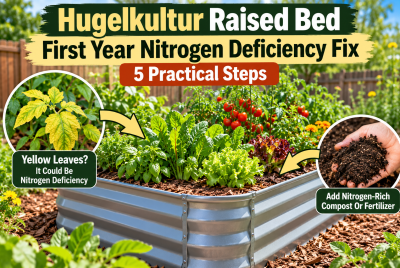
Important: Yellowing leaves do not automatically indicate nitrogen deficiency. Excess water, root problems, and other nutrient imbalances can produce similar symptoms.
7. Avoid Filling Shallow Beds With Large Hardwood Logs
Dense hardwood logs are not necessarily harmful, but they may be impractical in small raised beds.
Large pieces can occupy substantial space while decomposing slowly.
They may also create gaps that allow the soil surface to settle unevenly over time.
Consider a 4×4 raised bed that is only 12 inches deep. Filling the lower 6 inches with large logs leaves just 6 inches of planting medium before accounting for settling.
That is insufficient for many vegetables grown entirely within the bed.
A More Practical Approach
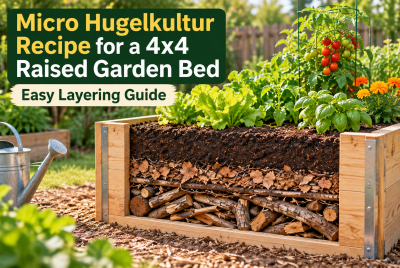
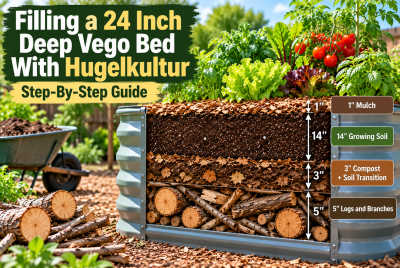
For an 18-inch-deep raised bed, one possible experimental arrangement is:
| Layer | Suggested Depth |
|---|---|
| Small untreated woody pieces | 3–4 inches |
| Leaves and small twigs | 1–2 inches |
| Finished compost-rich transition layer | 1–2 inches |
| Quality planting soil | At least 10 inches |
These are illustrative proportions, not research-established requirements.
For deeper-rooted vegetables or beds on impermeable surfaces, prioritize additional soil depth.
8. Use Caution With Resinous Softwoods
Pine, spruce, cedar, and other softwoods are sometimes described online as unsuitable for hugelkultur.
However, broad claims that all resinous wood poisons garden soil or makes it excessively acidic are not well supported.
Pine needles and wood do not necessarily cause significant, lasting changes in soil pH when incorporated into ordinary garden conditions.
The more relevant considerations are decomposition speed, wood size, species, and the physical characteristics of the material.
Cedar and some other naturally decay-resistant woods may persist longer than less resistant species.
Practical recommendation: Avoid using large quantities of freshly cut, highly resinous, or decay-resistant material when a small raised bed needs predictable settling and adequate planting soil.
Clean, untreated softwood is not automatically a contamination hazard.
9. Avoid Wood From Potentially Contaminated Locations
Even untreated wood can be unsuitable if it comes from an unreliable location.
Examples include wood collected from:
-
Industrial properties.
-
Chemical storage areas.
-
Fuel-contaminated sites.
-
Demolition sites.
-
Areas where wood was heavily treated with pesticides.
-
Locations with known soil or environmental contamination.
Contamination may not be visible.
A branch can look completely normal while carrying residues from its previous environment.
For vegetable gardening, knowing the material’s source is often more useful than judging its appearance.
How To Choose Safe Wood For Micro Hugelkultur
Once questionable materials have been excluded, selecting wood becomes relatively straightforward.
Step 1 – Identify The Species
Use branches from trees you can identify.
Avoid unknown species when plant compatibility is uncertain, particularly for beds intended for sensitive vegetables.
Step 2 – Confirm The Wood Is Untreated
Choose naturally fallen or pruned branches that have not been painted, preserved, sprayed, or exposed to contaminants.
Do not rely on appearance alone.
Step 3 – Prefer Smaller Pieces
For an 18-inch-deep raised bed, small branches and modest wood pieces are generally easier to arrange than large logs.
Their exact dimensions are less important than preserving enough planting depth and avoiding large voids.
Step 4 – Look For Partial Decomposition
Partially decomposed wood may be softer, darker, and easier to break apart.
Avoid material with suspicious chemical odors or evidence of contamination.
Ordinary fungal decomposition is part of the natural breakdown process and is not automatically a reason to discard wood.
Step 5 – Keep Wood Below The Main Root Zone
Place woody materials beneath a substantial layer of suitable planting soil.
For many vegetable beds, aim to preserve at least 10–12 inches of growing medium above coarse fill when the overall bed dimensions allow it.
If that is not possible, using conventional soil throughout the bed is often the better choice.
4 Common Wood Selection Mistakes
Mistake 1 – Assuming Natural Wood Is Always Safe
Natural materials can still contain plant-inhibiting compounds or environmental contaminants.
Fix: Identify the species and source before using the wood.
Mistake 2 – Treating All Pressure-Treated Wood As Identical
Modern and historical preservatives differ considerably.
Fix: Distinguish between labeled lumber intended for a particular application and unidentified scraps used as buried fill.
Mistake 3 – Using Too Much Wood To Save On Soil
Reducing soil costs can be appealing, but excessive woody fill sacrifices rooting volume.
Fix: Design the bed around the crops’ soil requirements rather than the amount of free wood available.
Mistake 4 – Ignoring Decomposition And Settling
Wood does not retain its original volume indefinitely.
Fix: Use smaller quantities of woody material, minimize large gaps, and replenish soil as needed between growing seasons.
Better Alternatives To Questionable Wood
If suitable wood is unavailable, there is no need to use risky material.
Several practical alternatives may work better.
| Alternative | Main Benefit | Best Application |
|---|---|---|
| Quality raised-bed soil | Predictable rooting environment | Vegetable beds |
| Finished compost | Adds organic matter and nutrients | Mixed into suitable soil |
| Shredded leaves | Reuses yard waste | Composting or surface mulch |
| Clean, aged wood chips | Organic surface cover | Mulching |
| Native mineral soil with compost | Can reduce purchased material costs | Where soil quality is suitable |
A conventional raised bed filled with appropriate soil and finished compost is often easier to manage than one containing a large volume of buried wood.
Surface mulching can also help conserve moisture without sacrificing rooting depth.
Frequently Asked Questions
Can I Use Cedar Wood In A Micro Hugelkultur Bed?
Clean, untreated cedar is not automatically harmful, but its natural resistance to decay may make it a less practical choice for a method that relies on decomposition. Small amounts are unlikely to create the same concerns as chemically treated wood. For a compact bed, less decay-resistant, partially decomposed branches may be preferable.
Is Heat-Treated Pallet Wood Safe For Raised Garden Beds?
An HT stamp indicates a heat-treatment process, not a guarantee that the pallet is free from contamination. Its previous cargo and storage conditions may be unknown. For vegetable-growing beds, avoid pallets with uncertain histories, even if they carry a heat-treatment mark. Clean, untreated branches from a known source are a simpler alternative.
Should I Remove Fresh Wood Already Buried In My Raised Bed?
Not necessarily. If the wood is clean, untreated, and correctly identified, immediate removal may not be needed. Monitor plant growth, soil moisture, and settling. If plants show possible nutrient deficiencies, investigate the cause before fertilizing. Remove the material if you discover that it was chemically treated or contaminated.
Final Thoughts
Understanding what wood to avoid in micro hugelkultur beds helps prevent avoidable gardening problems.
The highest priority is excluding chemically contaminated materials, railroad ties, painted scraps, and wood with an uncertain treatment history. Black walnut deserves additional caution around susceptible plants.
Fresh or slow-decomposing wood presents different concerns, mainly involving nitrogen availability, soil depth, and settling rather than toxicity.
For most small raised beds, the simplest choice is clean, untreated, partially decomposed wood from a known source—or no buried wood at all.
Before building your next bed, identify your materials, consider the crops you want to grow, and preserve enough quality soil for healthy root development.
For a practical example of layer depths and materials, see the related Eco Yard Guide article, Micro Hugelkultur Recipe For A 4×4 Raised Garden Bed: Easy Layering Guide.
Research And Further Reading
Explore more:
- Micro-Hugelkultur For Raised Beds — Pillar Hub
- How To Layer Micro Hugelkultur In Raised Beds
- Best Logs For Hugelkultur Raised Bed Foundation
- Filling A 24 Inch Deep Vego Bed With Hugelkultur
- Micro Hugelkultur Recipe For A 4×4 Raised Garden Bed